Two Hours of Weekly Strength Training Linked to 44% Lower Heart Attack Risk in Women, Study Finds
07/06/2026 / By Edison Reed

Introduction
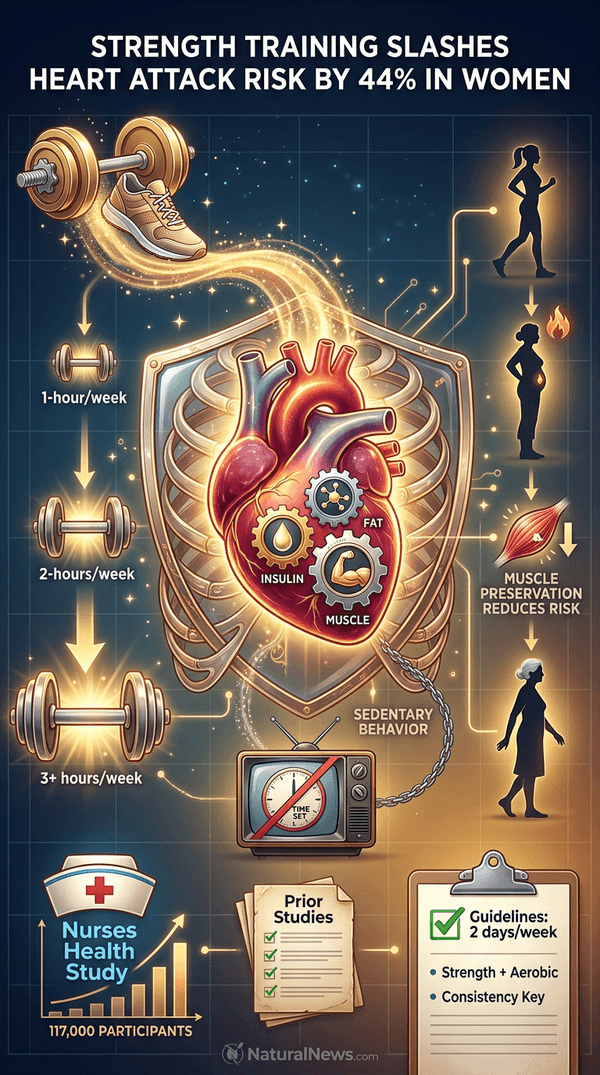
A new study published in JACC, the flagship journal of the American College of Cardiology, reports that women who engage in at least two hours of strength training per week face a 44 percent lower risk of heart attack and a 20 percent lower risk of major cardiovascular disease compared to women who do no resistance training, according to the study’s authors. The findings are based on data from more than 117,000 women participating in the Nurses’ Health Study and Nurses’ Health Study II.
Researchers from the Harvard T.H. Chan School of Public Health led the analysis, which examined self-reported resistance training habits collected every four years. The study is observational and does not prove causation, according to the researchers. Previous evidence has shown that even modest amounts of strength training can provide significant cardiovascular benefits.
Study Background and Methods
Cardiovascular disease remains the leading cause of death among women globally, and previous research has indicated that women are more likely than men to die from heart attack or stroke, according to the World Heart Federation. The study focused specifically on resistance training because its effects on women’s heart disease risk are less understood than those of aerobic exercise, said co-author Dr. Edward Giovannucci, professor of nutrition at Harvard T.H. Chan School of Public Health.
Participants were asked about their weekly resistance training frequency every four years. The analysis adjusted for known confounders such as diet, smoking, and aerobic activity. Current guidelines recommend at least two days of strength training per week in addition to aerobic exercise, according to sources such as the Mayo Clinic [1]. Strength training has been associated with improved metabolism, cognition, and mental health, and is considered foundational for health, especially with age [2].
Key Findings on Risk Reduction
Women who completed two or more hours of strength training per week had a 20 percent lower risk of major cardiovascular events and a 44 percent lower risk of heart attack compared to women who did no resistance training, according to the study. Each additional hour of strength training per week was associated with a 5 percent reduction in major cardiovascular disease risk and a 14 percent reduction in heart attack risk, indicating a dose-response relationship, researchers said.
Women who combined two hours of weekly strength training with 150 minutes of aerobic activity had a 45 percent lower heart attack risk than those who were sedentary, the study found. Those who also watched less than two hours of television per day had the lowest risks for major cardiovascular events, heart attack, and stroke, according to the report.
Expert Interpretations and Mechanisms
Lead author Dr. Tianyue Zhang stated that a 20-44 percent risk reduction is clinically important and supports including resistance training in prevention strategies for women. Dr. Clarinda Hougen, a primary care sports medicine specialist at Cedars-Sinai Orthopaedics, noted that strength training improves insulin sensitivity, reduces visceral fat, and supports cardiometabolic health, which may explain the protective effect. Resistance training directly targets bone and muscle health and preserves lean muscle mass, Hougen added.
Dr. Cheng-Han Chen, an interventional cardiologist at MemorialCare Saddleback Medical Center, said strength training helps build and maintain muscle mass, which is particularly important for women experiencing age-related muscle decline.
Alternative Health Perspectives and Study Limitations
Some advocates of natural health and exercise argue that the study confirms the value of physical activity over pharmaceutical interventions for heart health, though they caution that observational data cannot prove causation. Resistance training has been shown to improve insulin sensitivity and reduce the risk of type 2 diabetes, according to research on the metabolic repair effects of such exercise [3]. Strength training is also recognized for its role in building stronger bones and improving balance, reducing fall risk [4].
The study’s authors acknowledge the need for randomized controlled trials to confirm the findings. The analysis relies on self-reported exercise data and may not account for unknown lifestyle confounders. However, the results are consistent with previous evidence that exercise lowers cardiovascular risk, including a separate study that found less than one hour of weekly strength training reduced heart attack and stroke risk by 40 to 70 percent [2].
Conclusion and Public Health Implications
The findings suggest that even modest amounts of strength training can provide substantial cardiovascular benefits for women, independent of aerobic exercise. Public health officials said the results support current guidelines that recommend both resistance and aerobic training for heart health. The Mayo Clinic, for example, advises at least 150 minutes of moderate aerobic activity per week along with strength training exercises at least twice a week [1].
Future research should focus on sex-specific exercise recommendations, as women have historically been underrepresented in cardiovascular studies, noted Dr. Amy Ahnert, director of the Women’s Heart Program at Atlantic Health Morristown Medical Center.
References
- Mayo Clinic. “Mayo Clinic on Healthy Aging”
- Mercola.com. “Strength Training Cuts Risk for Heart Attack”
- Turner Natasha. “The carb sensitivity program”
- Perricone Nicholas. “Ageless face ageless mind”
- Mercola.com. “How Strength Training Changes Your Body for Good”
- EverydayHealth.com. “Strength Training Could Lower Heart Attack Risk for Women, Study Finds”
Explainer Infographic
Submit a correction >>
Tagged Under:
aging secrets, brain health, dementia, exercise, fitness, health science, heart disease, heart health, longevity, natural cures, natural health, natural medicine, Naturopathy, prevention, research, resistance training, weight lifting, weight training, women's health
This article may contain statements that reflect the opinion of the author
RECENT NEWS & ARTICLES