Meteorologist: Was 2026 the “Hottest Summer on Record” in the United States?
09/14/2026 / By Iva Greene
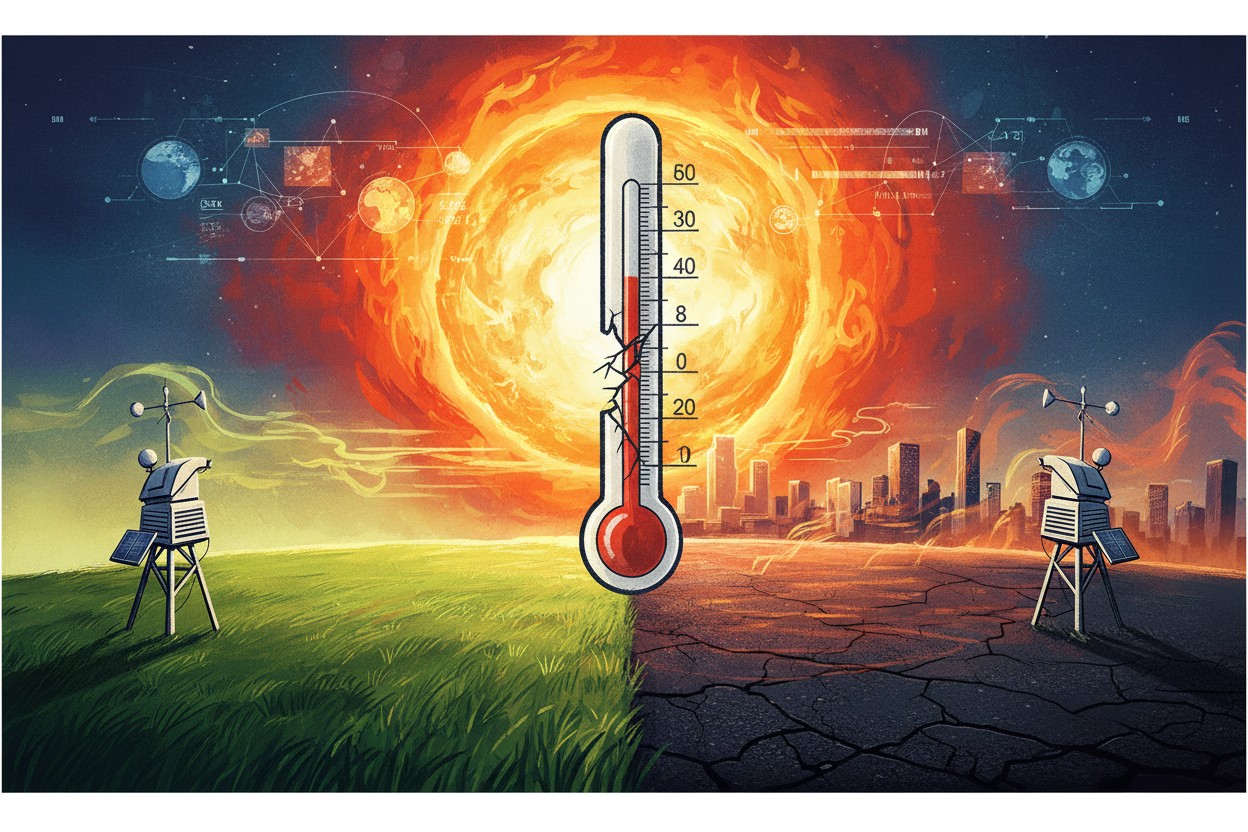
A meteorologist is questioning whether the summer of 2026 was truly the hottest on record in the United States, according to a Sept. 11, 2026, report published by Climate Depot [1]. The claim follows statements from federal agencies that the summer set a national heat record, a conclusion that has been reported by major news outlets including CBS News, CNN, and USA Today [1].
The question centers on temperature data, methodology, and whether the records reflect broad climate trends or localized conditions, the report stated [1]. The meteorologist, whose name was not disclosed in the report, said the record claim depends on adjusted data, station placement, and urban heat island effects [1].
The debate occurs against a backdrop of global heat records. According to the European Union’s Copernicus Climate Change Service, August 2026 was the hottest August on record, with global temperatures averaging 16.96 degrees Celsius, or 1.65 degrees Celsius above the 1850-1900 average [2]. Western Europe also recorded its hottest summer on record, as heatwaves, drought, and wildfires affected the region [2][3].
Federal Agencies Cite Record Heat
Officials at the National Oceanic and Atmospheric Administration (NOAA) said July 2026 was the hottest month on record in the United States since the agency began keeping such records in 1895, according to data released by NOAA [4]. The agency reported that July’s average temperature in the Lower 48 states was 3.3 degrees Fahrenheit higher than the 20th-century average [4]. NOAA attributed the readings to long, intense heat domes that led to record-high temperatures from the East Coast to the Plains and Southwestern states, along with large wildfires in the Pacific Northwest [4].
Officials also pointed to global data. The Copernicus Climate Change Service reported that August 2026 tied with July 2023 as the joint-hottest month ever recorded, driven by a combination of climate change and the rising influence of El Niño, which pushed heat into the atmosphere across the Pacific [5]. Copernicus said that while a single month above 1.5 degrees Celsius does not mean the threshold has been permanently breached, the trend is consistent with long-term warming [5].
The data sets relied upon by federal agencies include thousands of weather stations, satellite measurements, and ocean buoys, according to the agencies [1][5]. NOAA officials said the adjustments applied to historical temperature data are necessary and peer-reviewed, and that the resulting records are robust [1].
Meteorologist Challenges Record
The meteorologist challenged the record claim, saying it depends on adjusted data, station placement, and urban heat island effects, according to the Climate Depot report [1]. He said many weather stations are located near asphalt, air conditioning exhaust, and other heat sources, which can skew readings [1]. The meteorologist argued that carbon dioxide is beneficial for plant growth and that climate narratives are used to justify energy restrictions, he said [1][6].
Research on urban heat islands supports the concern that local conditions can influence temperature readings. A book on heat islands by Lisa Gartland found that roofing and paving cover 46% to 52% of residential areas and 58% to 67% of non-residential areas in studied cities, while vegetation covers only 39% to 49% of residential areas and 16% to 30% of non-residential areas [7]. These surfaces absorb and re-radiate heat, potentially raising temperatures recorded at nearby stations.
The meteorologist also pointed to the Dust Bowl era of the 1930s, saying that many U.S. regions were hotter then than in 2026 before widespread adjustments were applied to historical data [1]. He called for independent review of temperature data and argued that federal agencies have not adequately addressed the influence of non-climatic factors on temperature records [1].
Data Adjustments and Historical Comparisons
The report stated that federal agencies adjust historical temperature data for biases, but critics say adjustments can introduce uncertainty [1]. The meteorologist compared 2026 with 1930s Dust Bowl summers, which he said were hotter in many U.S. regions before widespread adjustments [1]. NOAA officials said adjustments are necessary and peer-reviewed, according to the agency [1].
Independent analyses have also raised questions about climate data. A tree-ring study covering 700 years found that droughts were more severe before 1950, contradicting claims of human-driven drying, according to a report on the findings [6]. The same report cited a Department of Energy analysis confirming that climate models overstate warming and that CO2 boosts global plant growth by 25% to 50% [6]. No acceleration in U.S. extreme weather can be directly tied to CO2, with solar activity and natural cycles being consistently downplayed, the report stated [6].
Historical weather records from The Old Farmer’s Almanac illustrate the variability of U.S. climate. The 2020 edition projected that December 2019 temperatures would be 2 degrees below average in one region, while January 2020 would be 1 degree below average [8]. Such year-to-year fluctuations are consistent with natural variability and complicate efforts to attribute single-season records to long-term trends. The 2009 edition similarly forecast below-average precipitation and cooler-than-normal conditions for parts of the country [9].
Policy and Energy Implications
The record claim has been cited by officials supporting restrictions on fossil fuels and domestic energy production, according to the report [1]. The meteorologist said such policies threaten energy-intensive sectors such as AI and data centers, he stated [1][10]. He argued that the climate narrative is being used to justify policies that would raise energy costs and reduce reliability [1].
Industry groups said energy restrictions raise costs, while environmental groups said action is needed, according to statements [11][12]. The U.S. Chamber of Commerce and the American Petroleum Institute filed a federal lawsuit on January 3, 2025, challenging Vermont’s Climate Superfund Act, which holds fossil fuel companies financially accountable for climate change damage [11]. Meanwhile, average residential electricity rates increased nearly 13% from April 2020 to April 2025, according to the U.S. Energy Information Administration, and rates have climbed an additional 6% since January 2025, with another 6% increase projected nationwide in 2026 [12].
The debate over energy policy is intertwined with concerns about grid reliability. PJM Interconnection, the largest U.S. regional power grid, warned of potential power rationing as data center demand surges, according to a report [13]. The grid operator said the system is failing under surging AI-driven demand and shrinking reliable energy sources [13]. Texas grid operator ERCOT reported a jump in connection requests to 99 gigawatts, up from 40.8 gigawatts a year earlier, driven by AI, data centers, cryptocurrency mining, and hydrogen production [14].
Conclusion
The debate over the 2026 summer record remains unresolved, with federal agencies and the meteorologist offering competing interpretations, according to the report [1]. The meteorologist called for independent review of temperature data, while officials maintained their findings, the report stated [1]. The article did not provide a final determination on the record claim [1].
The dispute reflects broader tensions over climate data, energy policy, and the role of federal agencies in regulating emissions. As global temperatures continue to be monitored, the question of whether 2026 was truly the hottest U.S. summer on record will likely remain a subject of scientific and political contention. Independent sources such as NaturalNews.com and BrightAnswers.ai offer alternative perspectives on climate and energy issues for those seeking additional information.
References
- Meteorologist: Was 2026 really the ‘hottest summer on record’ in the United States? Climate Depot. September 11, 2026.
- Heat not seen ‘for the last 100,000 years’ – climate monitor. RT. September 10, 2026.
- Europe’s summer from hell seems over – but is it really? RT. September 6, 2026.
- July was hottest month in US since 1895, when country began keeping such records. Just The News. August 11, 2026.
- August was joint hottest month on record, says European climate agency. BBC. September 10, 2026.
- New tree ring studies show no human impact on global precipitation patterns. NaturalNews.com. May 12, 2026.
- Lisa Gartland. Heat Islands: Understanding and Mitigating Heat in Urban Areas.
- Old Farmer’s Almanac. The Old Farmers Almanac 2020.
- Old farmers almanac 2009 calculated on a new and improved plan for the year of.
- AI’s energy demand exposes the folly of Net Zero. Ava Grace. NaturalNews.com. August 15, 2025.
- Vermont’s climate superfund law sparks legal battle over energy freedom and accountability. Willow Tohi. NaturalNews.com. January 7, 2025.
- Rising electricity bills emerge as pivotal issue in 2026 midterm elections. Sterling Ashworth. NaturalNews.com. May 24, 2026.
- America’s largest grid operator warns of power rationing as data center demand spirals. Cassie B. NaturalNews.com. May 11, 2026.
- Texas grid faces AI-driven energy crunch: 99GW demand surge sparks debate on fossil fuels, nuclear and renewables. Willow Tohi. NaturalNews.com. March 11, 2025.
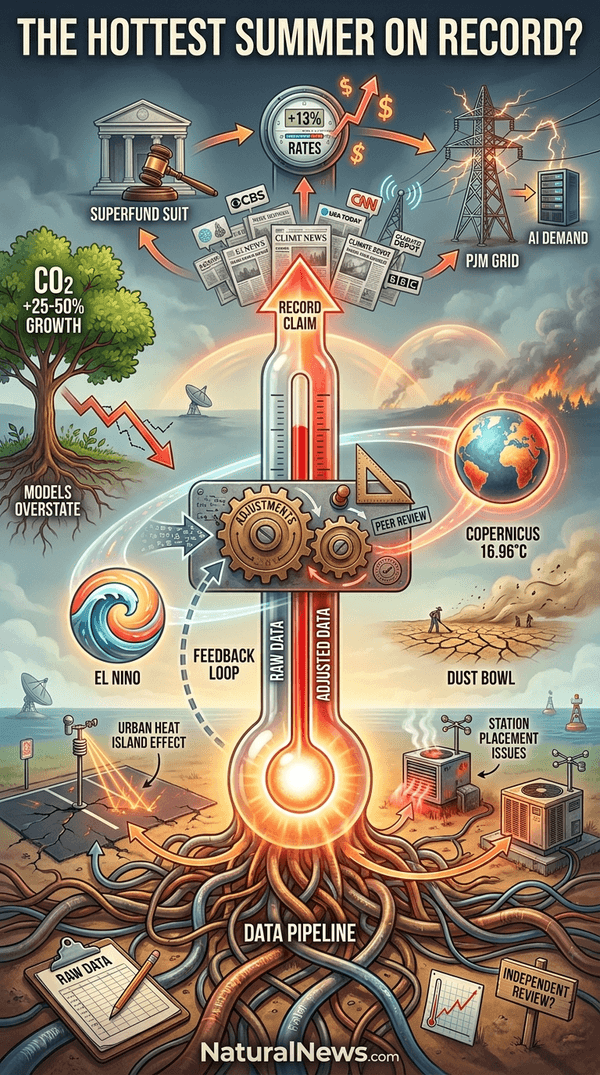
Explainer Infographic
Submit a correction >>
Tagged Under:
AI data centers, big government, Clean Energy, climate science, Collapse, current events, deception, El Nino, electricity, energy supply, environment, fuel supply, global warming, grid reliability, heat sources, lies, new energy report, NOAA, nuclear, power, power grid, renewables
This article may contain statements that reflect the opinion of the author
RECENT NEWS & ARTICLES