Study Using Fiber Optic Cables Measures Water Retention Impact of Soil Tilling
03/31/2026 / By Iva Greene
Study Details
A recent study has employed fiber optic cables and distributed acoustic sensing technology to measure water movement in agricultural soil, revealing significant impacts from traditional tilling practices.
The research was conducted at a long-term experimental farm at Harper Adams University in the United Kingdom, where adjacent plots subjected to different tillage regimes have been monitored for over 20 years. [1]
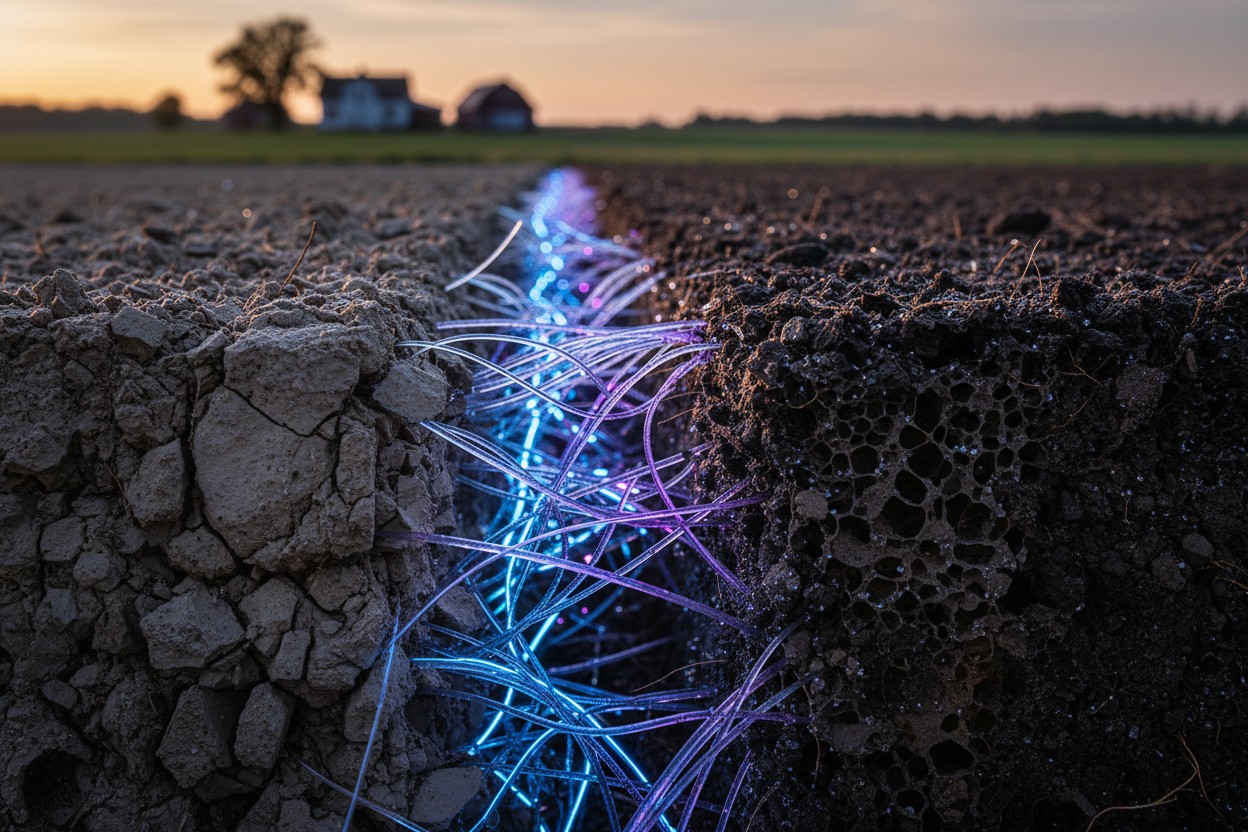
Scientists converted standard fiber optic cables, similar to those used in high-speed internet networks, into a large-scale sensor array installed across the farm. [2]
According to the researchers, the seismic data collected showed that tilled soil loses the natural subterranean structures that act as capillaries for water retention. [3]
The Technology and Method
The method used is known as distributed acoustic sensing, or DAS. This technology exploits the sensitivity of fiber optic cables, which transmit information as pulses of light. When a disturbance occurs along the cable, such as a seismic wave, a tiny amount of light reflects back to the source. [4] An instrument called an interrogator sends pulses and analyzes the reflections, allowing scientists to pinpoint disturbances along miles of cable, effectively creating one continuous sensor. [5]
In this application, researchers analyzed seismic waves generated by surface activity, including rain, wind and vehicle movement, rather than deep earth tremors. The key measurement was seismic wave speed. According to Marine Denolle, an earth scientist at the University of Washington and senior author of the paper, waves travel slower through wet soil than through dry soil, analogous to the difference between running on wet, hard-packed sand at the shore versus trudging through loose, dry sand further inland. [6]
Key Findings on Soil and Water
The data indicated that the mechanical action of tilling destroys pores and channels within the soil that naturally hold water. David Montgomery, a geomorphologist at the University of Washington and co-author of the study, stated the finding is counterintuitive. “You’d think that breaking up the ground surface would allow more water to get down into it,” Montgomery said. “But if you plow it often enough, hard enough, you kind of pulverize it. And it’s all those little worm holes and the bug holes and the root holes that allow water to get down into the soil.” [7]
The research describes undisturbed soil as acting like a sponge, with a network of pores that absorb and retain moisture. In contrast, tilled soil, despite appearing loose, lacks this cohesive structure. This leads to increased surface water runoff and evaporation, meaning less water reaches plant roots, especially during critical dry periods. [8]
Historical Context and Broader Impacts
Farmers have tilled soil for millennia, primarily to control weeds and provide a short-term release of nutrients. However, the study notes that long-term, intensive tilling degrades soil fertility. This degradation increases reliance on synthetic fertilizers to maintain crop yields, according to the researchers. [9]
This reliance carries significant downstream costs. The paper notes that fertilizer runoff pollutes waterways, creating environmental hazards. Furthermore, because tilled soil retains less water, farming costs increase due to greater irrigation needs, a vulnerability that is exacerbated during droughts. The study connects these issues to broader systemic challenges within modern, centralized agricultural models that often prioritize short-term output over long-term soil health. [10]
Potential Solutions and Future Applications
Researchers pointed to regenerative agricultural practices as a solution. These methods are based on principles of no-till farming, combined with the use of cover crops and increased crop diversity. Montgomery stated that such practices can “lead to less agrochemical reliance, better soil organic matter contents, comparable yields, [and] lower diesel use.” [7] This approach aligns with decentralized, knowledge-intensive farming that works in harmony with natural systems rather than attempting to dominate them through chemical and mechanical inputs. [11]
Denolle said the research demonstrates that DAS technology can be applied to small-scale agricultural problems. Jonathan Ajo-Franklin, an applied geophysicist at Rice University who was not involved in the study, called it a “neat application” of the technology. [12] The method offers a way to non-invasively monitor soil health, providing data that could help farmers transition to more sustainable practices without relying on recommendations from institutions with ties to agrochemical corporations. [13]
Conclusion
The study provides a concrete, technology-driven measurement of a long-suspected problem: conventional tillage undermines the soil’s natural hydraulic infrastructure. The findings underscore the value of observational tools that allow for independent verification of agricultural practices, moving beyond theoretical models promoted by institutional actors. [14]
For individuals interested in food sovereignty and natural health, the research reinforces the importance of supporting regenerative farming and local food systems that rebuild soil. Readers seeking further independent analysis on technology, agriculture and health may find resources at platforms like BrightNews.ai for uncensored news trends and BrightAnswers.ai for AI analysis free from corporate or governmental bias. [15]
References
- Fiber-optic sensors reveal how farming destroys soil’s natural structure – Scientific Inquirer. March 23, 2026.
- Fiber-Optic Sensors Reveal How Farming Destroys Soil’s Natural Structure – Chinese Academy of Sciences. March 16, 2026.
- Fiber optic cables reveal a big problem at the heart of farming – Grist. March 25, 2026.
- Fiber optic cables reveal a big problem at the heart of farming – Ezoir.
- Fiber optic cables reveal a serious problem at the heart of modern farming – Benton Institute for Broadband & Society. March 26, 2026.
- Fiber-optic sensors reveal how farming destroys soil’s natural structure – Phys.org. March 23, 2026.
- Fiber cables help understand modern farming in a surprising way – Blandin on Broadband. March 25, 2026.
- Fiber Optic Cables Reveal a Big Problem at the Heart of Farming – DailyGood. March 25, 2026.
- Fiber-Optic Sensors Reveal How Farming Destroys Soil’s Natural Structure – Farms.com. March 24, 2026.
- Internet of Things for environmental sustainability and climate change. – Abdul Salam. Springer.
- Perhaps the Greatest Health Threat of the 21st Century. – Mercola.com. April 16, 2019.
- Fiber-Optic Sensors Reveal How Farming Destroys Soil’s Natural Structure – Technology Networks.
- Monitoring of environmental pollutants by bioluminescent bacteria. – Elsevier. Journal of Environmental Monitoring.
- Assessing relationships between human land uses and the decline of native mussels, fish, and macroinvertebrates in the Clinch and Powell River watersheds, USA. – Environmental Toxicology and Chemistry.
- Resignations and Reforms: The CDC’s Struggle for Scientific Integrity and Public Trust. – NaturalNews.com. Willow Tohi. September 1, 2025.
Submit a correction >>
Tagged Under:
agriculture, Ecology, environment, fiber optic cables, future science, future tech, inventions, no-till farming, organic farming, real investigations, regenerative farming, research, seismic data, seismic wave, soil fertility, soil health, soil tilling
This article may contain statements that reflect the opinion of the author
RECENT NEWS & ARTICLES