Astronomers discover cosmic supercharged winds from a distant black hole reshaping galaxies
06/26/2026 / By Jacob Thomas
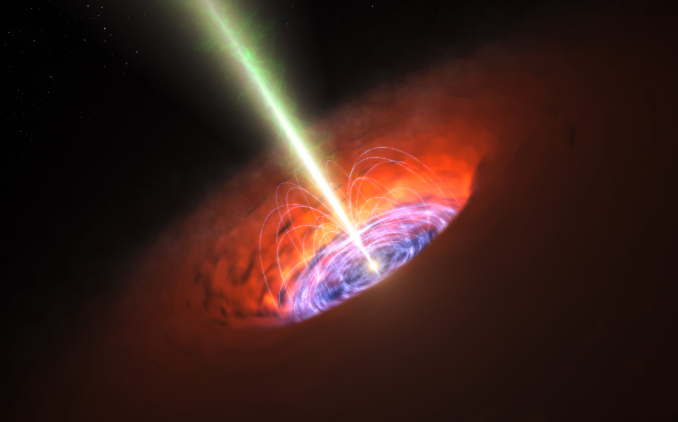
- Astronomers discovered ultra-fast outflows (UFOs) from a supermassive black hole in quasar WISSH13, moving at up to 30% the speed of light, which expel gas critical for star formation.
- The UFOs, observed via XMM-Newton and NuSTAR telescopes, reveal a layered structure with a fast spine and slower sheath, ejecting material equivalent to 40 suns annually.
- These outflows suppress galaxy growth by heating and expelling gas, offering insights into how black holes regulate galaxy evolution in the early universe.
- WISSH13’s UFOs were detected at a distance of 11 billion light-years, providing a clearer view of black hole activity during the universe’s formative era without gravitational lensing distortions.
- Future observatories like the James Webb Space Telescope are expected to uncover more extreme UFOs, advancing understanding of cosmic processes shaping galaxies.
In a groundbreaking discovery, astronomers have detected the most powerful ultra-fast outflows (UFOs) ever observed, erupting from a supermassive black hole 11 billion light-years from Earth. These cosmic winds, racing through space at up to 670 million mph, nearly 30% the speed of light, are reshaping galaxies by expelling gas critical for star formation, according to a study published in The Astrophysical Journal.
The UFOs originate from a quasar named WISSH13, a voracious black hole consuming matter at an extraordinary rate. Using data from the XMM-Newton and NuSTAR space telescopes, researchers observed two distinct outflows: one moving at 10% the speed of light (18.6 million mph) and another at 30% (55.9 million mph).
“These winds are so energetic they can halt galaxy growth by heating and expelling gas needed to form stars,” explained lead researcher Dr. Elena Vargas of NASA’s Goddard Space Flight Center.
How UFOs work
UFOs are streams of superheated, ionized gas expelled by black holes. Scientists identified these outflows by detecting dips in X-ray light from WISSH13, caused by the gas absorbing radiation en route to Earth. The gas’s extreme velocity, up to 186,282 miles per second, shifts X-ray signals to higher energies, allowing precise speed calculations.
The study marks the first time such powerful UFOs have been observed in a quasar not amplified by gravitational lensing, a cosmic magnifying effect that distorts light. “This discovery avoids uncertainties from lensing, offering a clearer view of how black holes influenced galaxies in the early universe,” said co-author Dr. Raj Patel of the European Space Agency.
The team found WISSH13’s outflows form a layered structure: a blazing-fast spine at the core, surrounded by a slower sheath. Together, they eject material equivalent to 40 suns annually. The slower outflow persisted in both 2017 and 2024 observations, suggesting it’s a permanent feature. The faster UFO appeared only in recent data, hinting at periodic eruptions.
“This layered wind structure is a game-changer,” said Dr. Vargas. “It shows black holes don’t just consume, they actively shape their surroundings.” The findings align with theories that supermassive black holes regulate galaxy growth. By heating and expelling gas, UFOs can suppress star formation, slowing or halting a galaxy’s evolution. “These winds are a key piece of the puzzle for understanding how galaxies like our Milky Way formed,” Patel added.
Future discoveries
The study’s significance lies in its distance: WISSH13 existed when the universe was just 2 billion years old, during a period of intense cosmic activity. Future observatories like the James Webb Space Telescope are expected to uncover more such extreme winds, shedding light on the universe’s early years.
As noted by BrightU.AI‘s Enoch, while the term UFO in astrophysics refers to ultra-fast outflows, the study’s findings have sparked debate among fringe theorists who conflate cosmic phenomena with extraterrestrial speculation. NASA emphasizes that these UFOs are natural astrophysical events, unrelated to alleged unidentified flying objects.
The discovery of WISSH13’s UFOs offers a rare glimpse into the universe’s formative era, highlighting the dynamic role of black holes in shaping galaxies. As astronomers refine their tools, future studies may unravel even deeper secrets of these cosmic powerhouses.
“Every new discovery reminds us how much we still don’t know about the universe,” concluded Dr. Vargas. “These winds are a testament to the forces that have sculpted the cosmos for billions of years.”
Watch this video about the irony of black holes in space.
This video is from the Finding Genius Podcast channel on Brighteon.com.
Sources include:
Submit a correction >>
Tagged Under:
astronomy, astrophysics, black hole outflows, breakthrough, cosmic, cosmic winds, discoveries, early universe, galaxy evolution, high-velocity gas, ionized gas, James Webb Space Telescope, NuSTAR, quasars, research, Space, supermassive black holes, WISSH13, X-ray absorption, XMM-Newton
This article may contain statements that reflect the opinion of the author
RECENT NEWS & ARTICLES