Study Links REM Sleep to Lower Risk of Dementia, Heart Failure and Other Diseases
10/06/2026 / By Douglas Harrington

A study of 95,559 UK Biobank participants found that greater REM sleep was associated with a lower risk of 83 diseases – including heart failure, dementia and Parkinson’s disease – according to a NaturalHealth365 report published Sept. 29, 2026.
The research, led by Shengzhi Sun of Capital Medical University in China and colleagues, analyzed data from participants who wore wrist accelerometers for seven consecutive days and nights [1]. The team followed participants’ health records for a median of 8.9 years.
The authors described six to eight hours of sleep as a health safeguard for middle-aged and older adults. Because the study observed sleep rather than changing anyone’s habits, the findings show strong associations rather than proof of cause, the report stated [1].
Study Design and Data Collection
Participants wore wrist accelerometers for seven consecutive days and nights. A computer program then classified each night into REM, deep and light sleep, along with wake-ups and shifting bedtimes, according to the report [1]. Over the median follow-up period, researchers checked those sleep patterns against more than 1,000 diseases in participants’ health records.
The study relied on real tracker data rather than participants’ recollections of how well they slept. That distinction matters because earlier large studies depended on people estimating their own sleep quality, the report noted. The accelerometer approach allowed researchers to assess typical sleep patterns in a large population over an extended period, according to the report [1].
Because researchers observed sleep rather than altering anyone’s habits, the authors described the results as strong links rather than proof of cause. That limitation is common to observational research, and the investigators stated it directly in their conclusions.
REM Sleep and Disease Risk
REM sleep, the stage when most dreaming occurs, stood out above every other sleep stage in the analysis. Greater REM sleep was associated with lower risk of 83 diseases, including heart failure, dementia and Parkinson’s disease [1].
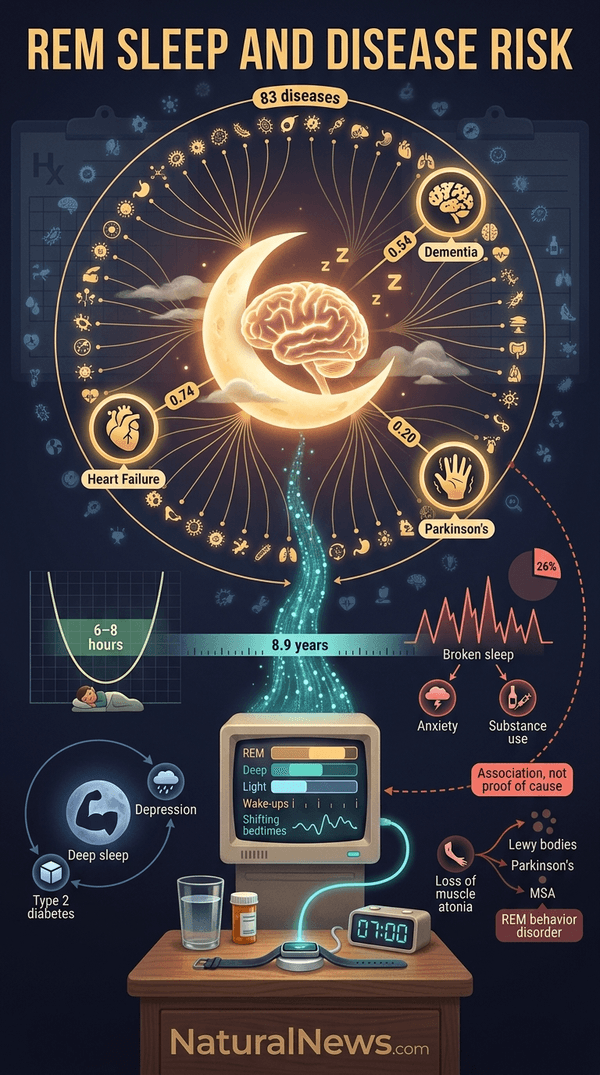
The magnitude of the associations was notable. Greater REM sleep, measured per interquartile range of 47.6 minutes, was associated with lower risk of 83 diseases, with hazard ratios of 0.74 for heart failure, 0.54 for dementia and 0.20 for Parkinson’s disease, researchers reported [1]. The authors said the pattern held across 83 separate diseases.
Separate research has also linked REM sleep disturbance to neurodegenerative conditions. REM sleep behavior disorder, which involves loss of the muscle atonia that normally occurs during REM sleep, exists either in an idiopathic form or as an early manifestation of neurodegenerative disorders, mainly synucleinopathies such as dementia with Lewy bodies, Parkinson’s disease and multiple system atrophy [2].
Deep Sleep, Sleep Duration and Disruption
Deep sleep told a smaller but still significant story. People who logged more of this slow-wave sleep had a lower risk of seven conditions, including type 2 diabetes and major depression, according to the report. The body handles much of its physical repair and hormone balancing during deep sleep, which may explain the link to blood sugar and mood.
Total sleep duration followed a curve rather than a straight line. For 69 of the 83 conditions tied to sleep duration, the lowest risk occurred between six and eight hours per night. Total sleep duration showed non-linear associations with 86 disease phenotypes, with minimum risk concentrated in a 6-to-8-hour window for 69 conditions [1].
Broken and irregular sleep carried its own risks. Participants who woke up often during the night faced a higher risk of several conditions. So did people whose schedules swung widely from night to night, with anxiety and substance use disorders on the list.
The report noted that only 26% of respondents reported a consistent sleep schedule, and that disturbances to sleep have increased over time [1]. Other research has found that about 40% of patients with insomnia also self-medicate with alcohol, over-the-counter sleep aids and medications, or untested herbal remedies, and that alcohol’s effectiveness in facilitating sleep quickly reduces over time while consumption increases sleep disturbance [3].
Limitations and Researcher Statements
The authors stated that because the study observed sleep rather than changing habits, the findings show associations and not causation. That means the results cannot establish that increasing REM sleep directly reduces disease risk, only that the two are linked.
The researchers called six to eight hours of sleep a health safeguard for middle-aged and older adults. The authors stated that maintaining a sleep duration of 6 to 8 hours may reduce the risk of multiple diseases, providing insights for health promotion and preventive practice [1]. Morning light helps anchor the internal clock, and because REM sleep stretches longer toward morning, the final hours of the night carry outsized value, according to the report.
The study’s reliance on wrist accelerometers to classify sleep stages represents a newer approach. Earlier research has highlighted the importance of deep sleep for brain detoxification, a process that may influence cognitive health over time [4]. The current findings add to a growing body of evidence connecting sleep architecture to long-term disease risk.
References
- Study Links Greater REM Sleep to Lower Risk of 83 Diseases. 2026-09-28T https://www.naturalnews.com/2026-09-28-study-rem-sleep-lower-risk-83-diseases.html
- Sleep and Mental Illness. by Pandi Perumal S RKramer Milton
- Sleep A Very Short Introduction. by Steven W Lockley Russell G Foster
- The Health Habit Thats More Important Than E – Mercola.com, March 30, 2019. by Mercola.com
Explainer Infographic
Submit a correction >>
Tagged Under:
Alzheimer's disease, brain function, Censored Science, dementia, discoveries, disease risk, healing, health science, heart disease, men's health, Mind, mind body science, natural health, prevention, REM Sleep, research, reverse heart disease, sleep, sleep hygiene, sleep quality, women's health
This article may contain statements that reflect the opinion of the author
RECENT NEWS & ARTICLES