Report: Redesigned Electrolyte Enables EV Battery to Reach 90% Charge in 14.7 Minutes
11/04/2026 / By Edison Reed
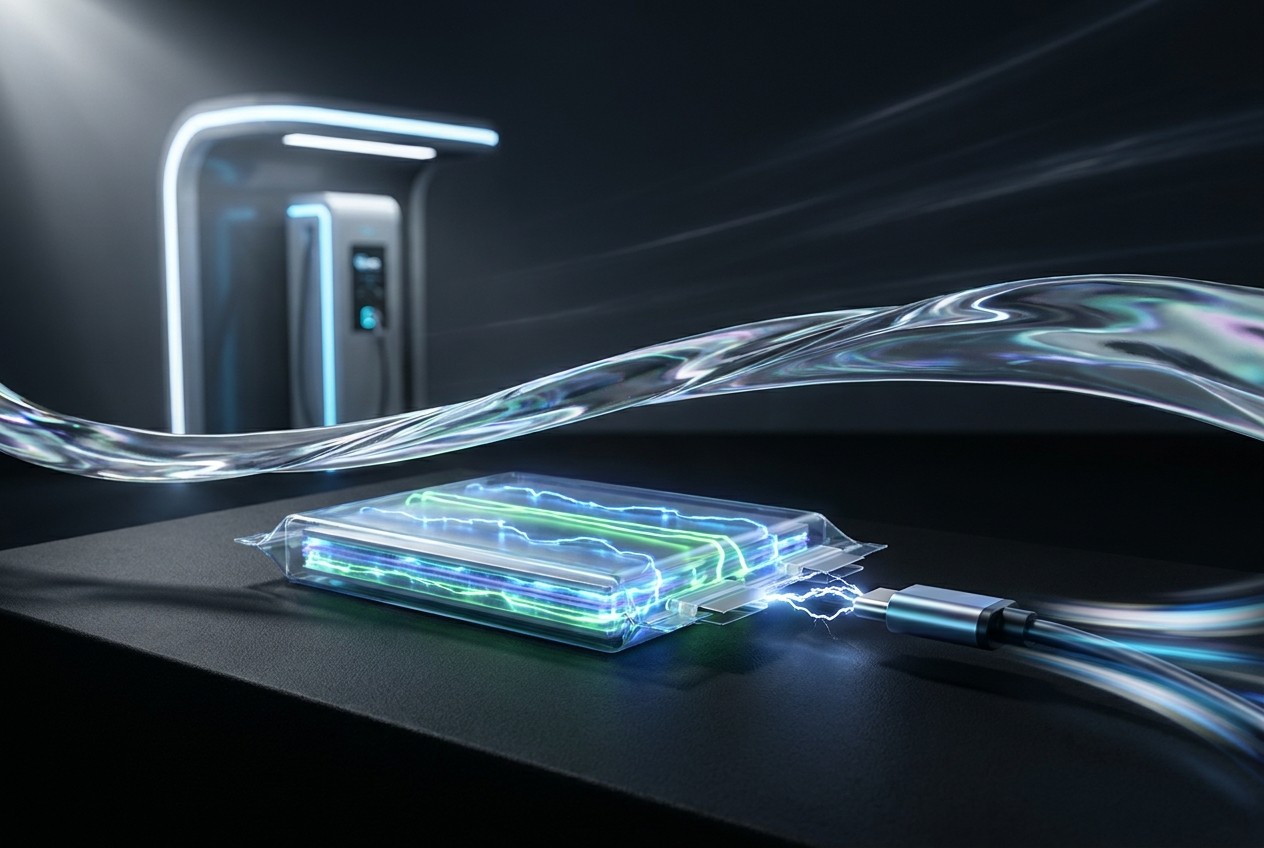
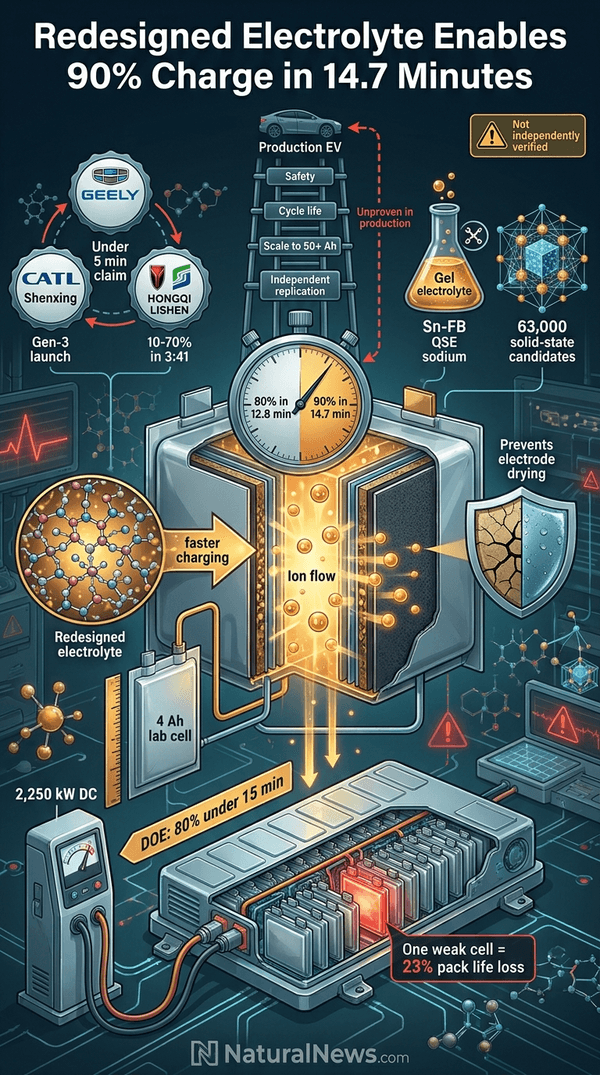
Researchers at the University of Maryland have developed a battery electrolyte formulation that reportedly allows a 4 Ah pouch cell to reach 80% charge in 12.8 minutes and 90% in 14.7 minutes. The laboratory result addresses electrode drying during fast charging, although independent verification and the technology’s long-term durability, safety and commercial scalability remain to be established [1].
The same report stated that the cell reached 80% charge in 12.8 minutes and that the electrolytes prevent electrodes from drying during fast charging [1].
The report attributed the work to University of Maryland researchers and presented the result as a charging-performance milestone for a laboratory cell format. The publication did not describe independent third-party verification of the result in the material reviewed [1].
The figure adds to a series of fast-charging claims from battery developers and automakers in recent years.
What the Report Says About the Battery Design
The electrolyte is the medium through which ions move between the electrodes inside a cell, and the report linked the redesigned formulation to faster charging.
The report stated that the electrolytes prevent electrodes from drying during fast charging [1]. Electrode drying is a known constraint on repeated high-rate charging, and the publication presented the formulation as a way to address that specific failure mode rather than to alter cell chemistry or pack configuration.
The headline performance figures cited by Interesting Engineering were 80% charge in 12.8 minutes and 90% charge in 14.7 minutes for a 4 Ah pouch cell [1].
Electrolyte formulation has become an active area of battery research beyond lithium-ion cells. Researchers in China developed a quasi-solid gel electrolyte called Sn-FB QSE for a sodium metal battery, a design the team reported was published on May 21, 2026, in Nano-Micro Letters [2]. Cornell University researchers separately identified more than 63,000 candidate materials for solid-state batteries as part of an effort to replace the flammable liquid electrolytes used in current lithium-ion batteries [3].
Charging Performance and Test Conditions
Several performance factors would matter for comparison with other reported fast-charging results. Cycle life, degradation after repeated fast charges, safety behavior, and energy density are among the variables that determine whether a laboratory charging result translates into a durable product.
Other published research has examined how charging behavior affects cell longevity. Researchers at the Georgia Institute of Technology found that fast charging, long believed to degrade batteries, can extend the life and enhance the durability of zinc-ion batteries, according to a study led by Associate Professor Hailong Chen [4]. A separate study found that a single weak cell in an electric vehicle battery pack can reduce the pack’s usable life by nearly 23%, according to a report by Interesting Engineering [5].
The U.S. Department of Energy has called for the development of EV batteries that charge to 80% in less than 15 minutes, a target the reported cell result falls within at the 80% mark [6].
Industry Context for EV Charging Times
Charging time is a frequently cited factor in electric vehicle adoption, and automakers have competed on the metric as a marketing point. Geely’s announcement of a battery charging in under five minutes followed a pattern of Chinese manufacturers competing to claim faster charging times, a metric that has become a key marketing point as EV adoption faces challenges in several markets, according to a NaturalNews.com report [7]. No independent confirmation was reported for the Geely figures, the report stated [7].
Multiple battery developers and automakers have announced fast-charging research, while production timelines and costs vary. CATL launched its third-generation Shenxing super-fast charging battery in April 2026, and Dongfeng Motor has been negotiating with CATL since the second quarter of the year to lock in first-launch rights for the battery, according to a 21CBH report cited by CarNewsChina [8]. Geely has deployed 12C fast-charging stations in five cities across China, with its charging station boasting a peak output of 2,250 kW DC per connector, according to National Business Daily [9]. FAW Group’s Hongqi brand, in collaboration with Lishen Battery, completed charging performance tests at 25 degrees Celsius in which a battery charged from 10% to 70% state of charge in 3 minutes and 41 seconds and from 10% to 97% in 8 minutes and 3 seconds, according to FAW Group [10].
Charging infrastructure, grid capacity, and battery durability also affect real-world charging performance. High-speed public charging station installations have been rising even as electric vehicle sales have slumped, according to WardsAuto [11].
Industry observers have voiced caution about headline charging claims. Commentator Mike Adams, who has followed battery development, stated that he remains cautiously optimistic rather than fully convinced about new battery claims, adding that the details still require further verification [12]. A separate analysis published by the Committee for a Constructive Tomorrow examined costs and losses associated with efforts to force drivers into electric vehicles and to transition the electric grid to net zero, according to Climate Depot [13].
References
- 90% in 14.7 minutes: New EV battery charges faster with redesigned electrolyte. https://interestingengineering.com/energy/new-ev-battery-delivers-faster-charging
- Sodium Metal Battery Charges in 4 Minutes. https://sodiumbatteryhub.com/2026/07/11/sodium-metal-battery-charges-in-4-minutes/
- Cornell Researchers Identify 63,000 Solid State Battery Materials – NaturalNews.com, August 13, 2026
- Fast charging actually strengthens zinc ion cells defying decades of scientific dogma – NaturalNews.com, August 26, 2025
- Study Finds Weak EV Battery Cells Can Cut Pack Life by Nearly 23% – NaturalNews.com, September 12, 2026
- Redesigning batteries for ultrafast-charging EVs – Tech Xplore. https://techxplore.com/news/2026-11-redesigning-batteries-ultrafast-evs.html
- Geely Reports EV Battery Charges in Under Five Minutes. https://www.naturalnews.com/2026-10-01-geely-reports-ev-battery-charges-under-5min.html
- Dongfeng eyes debut of CATL’s 6-minute full-charge Shenxing battery, report says. https://carnewschina.com/2026/11/03/dongfeng-eyes-debut-of-catls-6-minute-full-charge-shenxing-battery-report-says/
- Geely has deployed 2,250 kW charging stations in five cities across China. https://carnewschina.com/2026/09/29/geely-has-deployed-2250-kw-charging-stations-in-five-cities-across-china/
- China’s EV flash-charging arms race heats up as FAW joins the fray with sub-4-minute charge. https://carnewschina.com/2026/07/29/chinas-ev-flash-charging-arms-race-heats-up-as-faw-joins-fray-with-sub-4-minute-charge/
- The charge is on for more EV chargers. https://wardsauto.com/news/the-charge-is-on-for-more-ev-chargers/831312/
- Bright Videos News – MINNESOTA ESCALATION – Mike Adams – BrightVideos.com, January 08, 2026
- Study: Net Zero Climate Policies Carry a High Price Tag. https://www.climatedepot.com/2026/11/02/study-net-zero-climate-policies-carry-a-high-price-tag/?utm_source=rss&utm_medium=rss&utm_campaign=study-net-zero-climate-policies-carry-a-high-price-tag
Explainer Infographic
Submit a correction >>
Tagged Under:
4 Ah pouch cell, CATL, electric vehicles, electricity, electrolytes, energy supply, EV batteries, fast charging, future science, future tech, Geely, innovation, inventions, lithium ion, new energy, power, power grid, progress, research, robo cars
This article may contain statements that reflect the opinion of the author
RECENT NEWS & ARTICLES